
China has become a major sourcing base for Pcb Control Board products, serving automation, consumer electronics, medical equipment, vehicles, and energy systems. Its manufacturers range from compact prototype workshops to highly automated factories with large-scale production lines. Buyers must look beyond price. Material selection, circuit layout, component availability, assembly accuracy, and after-sales support can determine the final product’s reliability.
Dr. Hayao Nakahara, a respected PCB industry analyst, once stated, “The PCB industry is the foundation of the electronics industry.” This observation remains highly relevant. A dependable Pcb Control Board begins with controlled impedance, suitable copper thickness, stable laminates, and careful thermal design. Qualified suppliers should also provide design-for-manufacturing reviews, functional testing, inspection records, and clear component traceability. These details matter when a board operates inside a cabinet with heat, vibration, dust, or limited maintenance access.
Real experience often reveals uncomfortable gaps. A polished factory tour does not guarantee consistent batches. A low quotation may hide weak testing or unstable sourcing. No supplier is perfect. Even capable manufacturers can face component shortages, engineering changes, or communication delays. Therefore, this guide examines China’s leading Pcb Control Board manufacturers and suppliers through practical criteria, including production capability, quality systems, customization, delivery performance, and technical communication. Readers should verify current certifications and samples independently. That step takes time. It can prevent expensive rework later.
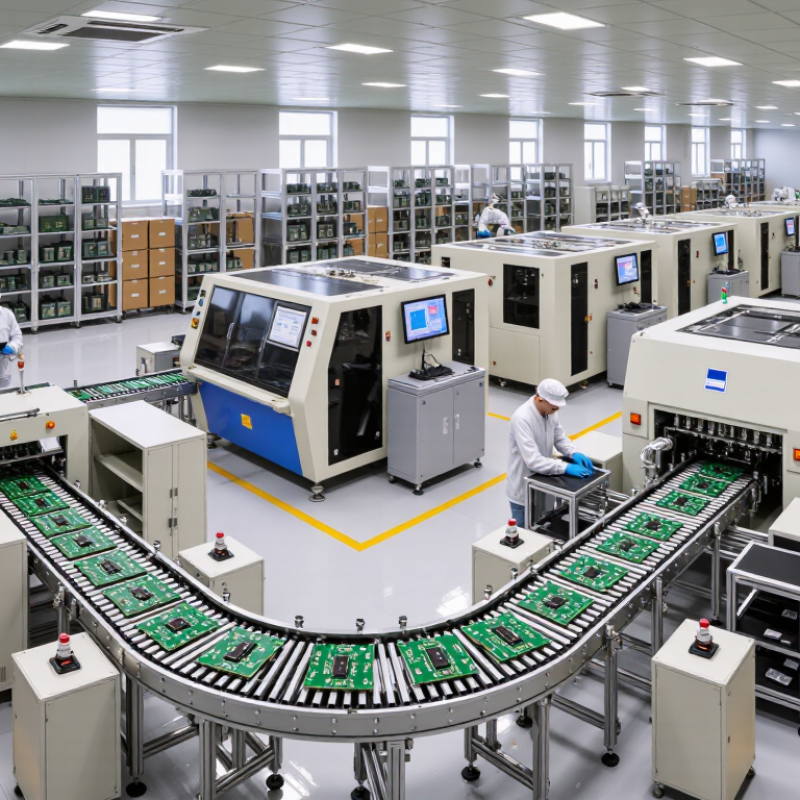
PCB control boards translate electrical plans into dependable machine actions. Their layer count usually ranges from 2 to 12 layers.
Two-layer boards suit simple relays, sensors, and low-density controllers.
Four-layer designs improve grounding and signal routing.
Higher counts support compact layouts, power separation, and controlled impedance.
FR-4 remains a practical substrate for many industrial control boards. Its glass-reinforced epoxy structure offers stable insulation and useful mechanical strength. However, FR-4 is not automatically suitable for high-temperature or high-frequency conditions. Thermal testing still matters. I have seen boards pass visual inspection but fail after repeated heat cycles. Small errors matter. Engineers should review copper thickness, via quality, solder-mask coverage, and connector durability before approval.
IPC Class 2 commonly fits general industrial equipment where continued performance matters. IPC Class 3 demands tighter workmanship and inspection for products requiring higher reliability.
The correct class should match the machine’s operating risk, service environment, and expected lifespan.
A reliable manufacturer should provide traceable material records, inspection reports, and electrical test results. Suppliers should also clarify whether testing covers bare boards, assembled boards, or both. This detail is often overlooked. Layer count alone does not prove quality; clean documentation and repeatable production provide stronger evidence.

China Top PCB Control Board Manufacturers and Suppliers
China’s PCB market has become a central force in global electronics manufacturing. By production value, China accounts for more than 50% of global PCB output. This scale reflects strong capacity in materials, fabrication, assembly, and testing. Dense supplier networks can shorten lead times and support faster engineering changes. They also create intense price competition. Low cost does not always mean dependable performance.
Experienced buyers usually assess more than a supplier’s quotation. They review layer control, copper thickness, drilling accuracy, solder-mask quality, and electrical testing records. Factory audits can reveal practical details, such as storage conditions and production discipline. Reliable suppliers should provide traceability from raw materials to finished control boards. International quality systems are useful, but daily process control matters more. No supplier is flawless. Even capable factories may need improvement in documentation or communication.
Tips: Request sample boards before placing volume orders. Confirm tolerance requirements in writing. Check testing methods, inspection records, and delivery history. Ask how the supplier handles engineering changes and rejected units. A clear agreement reduces confusion, although it cannot remove every production risk.
China accounts for more than half of global printed circuit board production value, making it the largest manufacturing base in the global PCB industry.
The chart visualizes the reported threshold: China is shown at the minimum value of 50.1%, while the remaining global market is shown at the corresponding maximum of 49.9%. These boundary values represent “over 50%” rather than an exact market estimate.
Source: Publicly reported industry summaries on global PCB production value.
When comparing Chinese PCB suppliers, 0.1 mm trace and space capability deserves careful verification. This geometry is close to 4 mil, but the number alone proves little. Copper thickness, layer count, board size, and etching compensation can change the result. Experienced suppliers should provide capability data, sample cross-sections, and inspection records from similar control boards. A clean sample may look excellent, yet production consistency is more important.
Impedance control within ±10% also requires engineering evidence. Ask for the finished stack-up, dielectric thickness, copper weight, and target impedance before ordering. Reliable factories normally use test coupons and TDR measurements for critical high-speed nets. Compare the measured values with the approved stack-up, not only with a sales specification. In practice, supplier documents can be incomplete or overly optimistic. That weakness deserves discussion before mass production. A small pilot run may reveal registration drift or unexpected line-width loss.
Tips: Request three recent test reports for 0.1 mm features. Confirm whether measurements use finished boards. Check coupon locations, test frequency, and acceptance limits. Ask how the supplier controls trace width after plating. Keep one approved cross-section as the production reference. Do not assume every layer reaches the same resolution. Review solder mask clearance, surface finish, and drilling alignment too. A technically strong supplier should explain limitations clearly, even when the answer is inconvenient.
China’s top PCB control board manufacturers are often evaluated through documented quality systems, not attractive product pages. ISO 9001 shows that processes are planned, measured, and reviewed across purchasing, assembly, inspection, and corrective action. In practical production, this may mean controlled work instructions, traceable material records, and inspection data linked to each batch.
For automotive control boards, IATF 16949 adds stricter expectations. It emphasizes risk analysis, process capability, defect prevention, and disciplined supplier management. A reliable supplier should explain how it handles soldering profiles, component substitutions, electrical testing, and field-return investigations. Ask for recent audit evidence. Certificates can expire.
UL recognition supports safer design and material choices for relevant applications. RoHS compliance helps control restricted substances in components, solder, and surface finishes. Yet a declaration alone is not enough. Manufacturers should maintain supplier declarations, material records, and testing plans. Small details matter, such as verifying laminate data before production begins.
Experience also appears in the factory’s response to uncertainty. Can engineers identify a weak solder joint under magnification? Can they separate a design issue from a process issue? These answers reveal more than a certificate wall. Quality systems reduce risk, but they do not remove it. Even experienced teams may miss an unusual failure mode, so honest reporting and continuous review remain essential.
| Quality Credential or Standard | Formal Reference | Primary Scope | Control Board Relevance | Evidence to Request from a Supplier |
|---|---|---|---|---|
| Quality Management System | ISO 9001:2015 | Process control, documented procedures, corrective action, risk-based thinking, and continual improvement. | Supports consistent PCB fabrication, assembly control, inspection records, and complaint handling. | Valid certificate, certification scope, issuing certification body, site address, and expiration date. |
| Automotive Quality Management | IATF 16949:2016 | Automotive quality management requirements, including defect prevention, variation reduction, and supply-chain controls. | Relevant for automotive control boards requiring traceability, process capability, change control, and failure analysis. | Current IATF certificate, covered manufacturing site, scope of activities, and certificate verification details. |
| PCB Flammability Recognition | UL 796; UL 94 material flammability classifications | Safety evaluation of printed wiring boards and flammability performance of polymeric materials. | Helps confirm that specified board materials and constructions meet applicable electrical safety requirements. | UL file or recognition information, approved material system, board construction, and applicable flammability rating. |
| Restricted Substances Compliance | RoHS Directive 2011/65/EU and Delegated Directive (EU) 2015/863 | Restriction of specified hazardous substances in electrical and electronic equipment. | Supports compliant selection of laminates, solder, surface finishes, components, and cable materials. | Supplier declaration, material declarations, test reports, and supporting records for homogeneous materials. |
| Printed Board Performance | IPC-6012 | Qualification and performance specification for rigid printed boards. | Provides a technical basis for evaluating dimensional accuracy, plated holes, electrical performance, and board reliability. | Declared IPC class, applicable revision, inspection plan, test coupons, and acceptance criteria. |
| Board Acceptability | IPC-A-600 | Visual and dimensional acceptability criteria for printed boards. | Helps define acceptable conditions for solder mask, copper features, laminate surfaces, holes, and board edges. | Inspection standard, workmanship criteria, sample inspection reports, and nonconformance records. |
| Assembly Workmanship | IPC-A-610 | Acceptability requirements for electronic assemblies. | Useful when the supplier provides PCB assembly, soldering, component placement, inspection, and rework services. | Declared product class, operator training records, AOI or X-ray capability, and sample assembly reports. |
| Traceability and Process Control | Supplier-defined manufacturing control system | Lot identification, material control, engineering change management, process monitoring, and record retention. | Reduces the risk of unidentified materials, uncontrolled revisions, mixed lots, and repeated production defects. | Lot codes, traveler records, change notices, incoming inspection records, and defined retention periods. |
| Typical Technical Capability to Confirm | Project-specific capability statement | Layer count, board thickness, copper weight, minimum trace and spacing, hole technology, surface finish, and panel size. | Confirms whether the supplier can manufacture the required control-board design without relying on unsupported general claims. | Manufacturing capability matrix, design-rule document, first-article report, and sample build approval. |
| Recommended Qualification Method | Document review, sample evaluation, and production audit | Independent verification of certificates, manufacturing capability, quality records, and product performance. | Provides stronger assurance than certification claims alone when selecting a PCB control-board supplier. | Audit checklist, approved sample, inspection results, corrective-action response, and periodic certificate revalidation. |
Note: Certification scope, validity, manufacturing site, product category, and applicable standard revision should be verified directly with the supplier or the issuing certification body before purchase.
Choosing a PCB control board manufacturer requires more than comparing unit prices. Capacity and delivery schedules often determine whether a product launch stays on track. Experienced suppliers should explain their prototype process, material availability, engineering review, and test coverage. For standard prototypes, a realistic target is five to ten working days. That window may include design checks, fabrication, assembly, and inspection. Ask what the quoted days actually cover. Do not assume shipping is included. Clear answers show operational maturity.
Tips: Send complete Gerber files, drill data, bills of materials, and assembly drawings. State layer count, board thickness, copper weight, impedance needs, and inspection expectations. Request a written schedule with approval points. A small pilot run can expose soldering, warpage, or component-sourcing problems before volume production. It may feel slower. It usually prevents rework.
For volume runs, three to eight weeks is a practical planning range when materials and specifications remain stable. Reliable suppliers reserve production capacity, track critical components, and provide progress updates before delays become visible. Ask how they manage engineering changes, incoming inspection, electrical testing, and final packing. Delivery performance should be measured over repeated orders, not one successful shipment. A single overlooked connector can disrupt an entire schedule. No forecast is perfect. Build buffer days into the launch plan, because real factories sometimes need them.
Please fill out this form and we will get an order or estimate ready for you. Please give us as much detail as you can for us to get started, and we will contact you to finsh the work order.